
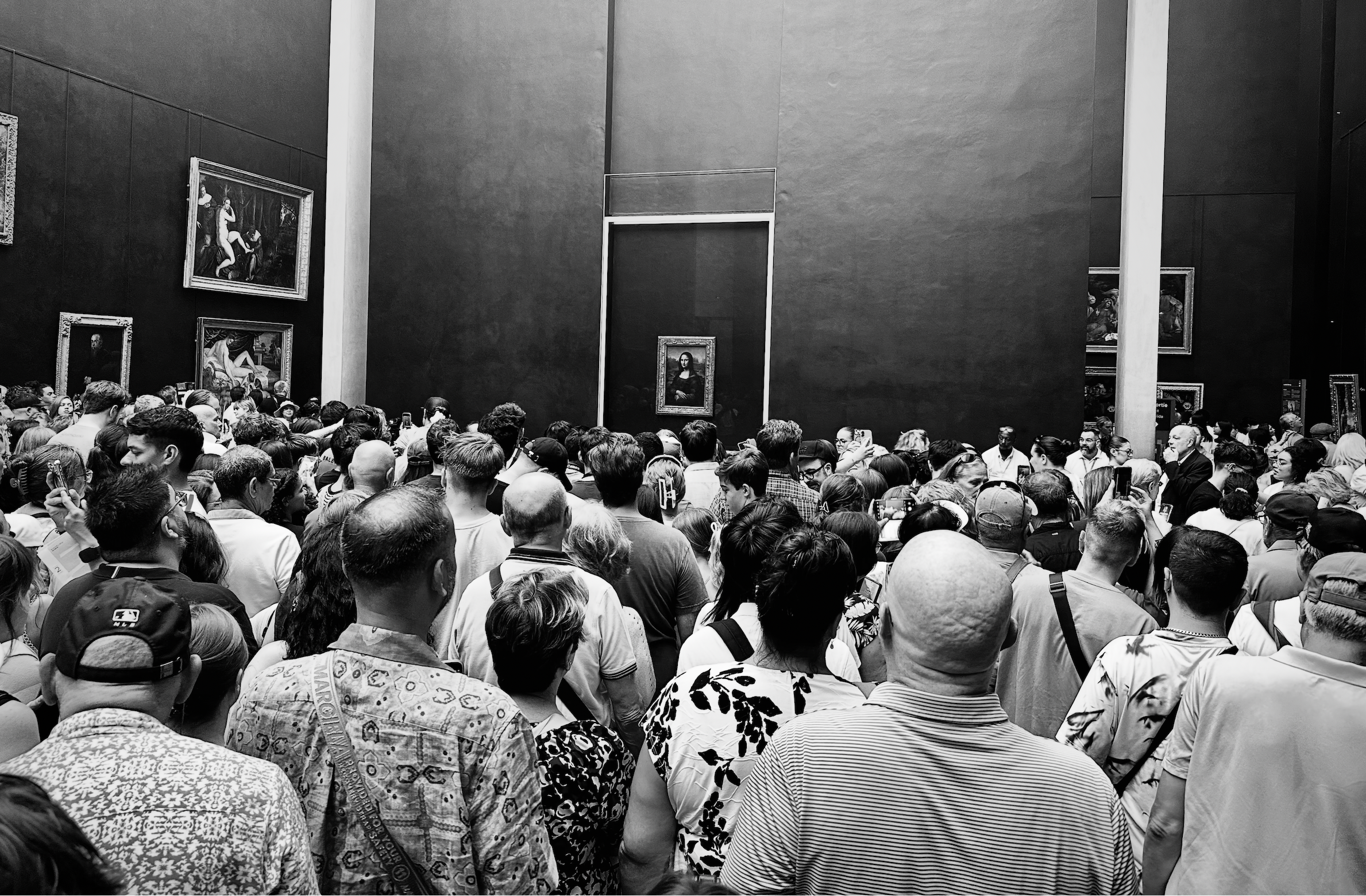
Standing before Leonardo da Vinci’s Mona Lisa at the Louvre, I was struck by a strange realization: I had traveled thousands of miles to see one of the most famous paintings in the world, yet I never truly encountered it.
The painting itself remains extraordinary. Even from a distance, it exerts a quiet force. Five centuries after it was painted, people still cross oceans simply to stand in its presence. I imagined what it might have been like to approach it slowly, to study the subtle brushwork, the mysterious smile, the traces of Leonardo’s hand. I wanted the intimate experience that art promises.
Instead, I found a spectacle.
The Mona Lisa hangs high above the crowd, isolated behind bulletproof glass and framed by a massive wall constructed to manage the endless stream of visitors. Security personnel direct the flow with practiced precision. The crowd surges forward, phones raised overhead. For a few seconds, people capture an image. Then they are moved along and ushered toward the exit. The process repeats endlessly, thousands of times each day.
What fascinated me most was not the painting itself but the crowd gathered before it.
Nearly a century ago, Walter Benjamin argued that works of art possess an “aura,” a unique presence rooted in their originality, history, and physical existence. Mechanical reproduction, he suggested, transforms our relationship with art. As images become infinitely reproducible, the aura of the original begins to fade. The copy becomes more familiar than the object itself.
Standing in the Louvre, I wondered whether Benjamin’s prediction had reached its logical conclusion.
Everyone in the room had already seen the Mona Lisa countless times before arriving. It appears in books, documentaries, advertisements, websites, souvenirs, and social media feeds. The image is everywhere. What people seemed to seek was not the painting itself but confirmation of their relationship to the image. The smartphone photograph served as proof. Not proof that they had seen the painting, but proof that they had been present within the spectacle surrounding it.
The crowd’s attention rarely settled on the work itself. Instead, it oscillated between the painting and the screens held in front of it. The original masterpiece stood only yards away, yet it was constantly being transformed back into reproductions. The aura of the artwork competed with thousands of tiny digital copies being manufactured every minute.
There was something unsettling about the entire arrangement. The system was remarkably efficient. Human beings moved through the gallery like units in a carefully engineered process. Advance. Photograph. Exit. The experience felt less like contemplation and more like consumption. The individual encounter with the artwork had been subordinated to the management of mass demand.
In that moment, the Louvre seemed to embody a peculiar fusion of control and commerce. The world’s most famous painting had become a destination, a brand, an image circulating through global culture. The institution successfully delivers access to millions, yet what is delivered is often not an encounter with the artwork but participation in a ritual. The image has become more important than the experience.
And yet, perhaps Benjamin would not be surprised.
The tragedy is not that the Mona Lisa has lost its aura. The tragedy is that so many people arrive searching for it and find themselves distracted by its reproductions. The painting remains there, silent and unchanged, carrying five hundred years of history within a small wooden panel. But around it swirls a modern world obsessed with documentation, replication, and proof of participation.
I left the Louvre convinced that the Mona Lisa is still a masterpiece. I also left wondering whether the most revealing artwork in the room was not Leonardo’s painting at all, but the crowd gathered before it. In their raised phones, hurried movements, and desperate attempts to capture an image they had already seen a thousand times, they revealed something profound about life in the age of mechanical — and digital — reproduction. The aura was still present. We simply struggled to see it.